


Create a clear strategy — and free up time
Leaders who are precise in their conveyance of vision, mission, and strategy may have found the key to success. Read here why you need to have a clear vision, mission and strategy and get advice on how to do it. You will also get an easily accessible dictionary of the concepts.
There is both momentum, finances and time to be gained in a clear and manageable strategy. If the strategy is to be useful and relevant for both you and your employees, there must be clarity about what the strategy is — and why it is there.
Vision, mission and strategy are all about what happens in everyday life; about how the task is solved, how priorities are prioritized between which tasks, and how to collaborate with colleagues and citizens get together. So there is a translation task that managers have not succeeded in. Without the common direction and understanding of the core task, for example, each teacher will meet the children as they think best, but may actually antagonize a colleague.
It is easy to mix up the concepts and use them interchangeably. Values are exalted into visions. The word 'strategy' is diluted and described untangibly in some contexts.
There is a need to address the confusion so that there is clarity about the use of language. What do we need with a strategy, what does a vision mean, why should we have a mission, and what is the difference?
DICTIONARY: Understand the concepts
Vision - What We Want
A vision is a picture of your desired future, and it describes what you strive for and the impact you want to have on your surroundings. A vision is often defined for 10-30 years.
What difference do you want to make?
Mission - What We Need
A mission is the fundamental purpose of your organization. The foundation of your raison d'être and contribution to the world. A mission is often fixed and formulated as the core mission.
Why do you exist as an organization?
Strategy - What we prioritize
The strategy describes what the organization wants to focus on in order to fulfill its vision and mission - options and priorities. A strategy is often defined for 3-10 years at a time and consists of stakes and goals.
What will you focus on in the coming years?
Goal - Dreams with deadline
The objectives are part of the strategy and are what we want to achieve more specifically and explicitly within the framework of the strategy within a set timeframe.
When do you know you are on target with your strategy?
Efforts - What We Do
Efforts are part of the strategy and are what everyone has to do and act on in order to reach the goal. There must be concrete action plans for the priority actions in terms of who does what and when.
How will you work to implement the strategy?
Values - What we live by
Values are the principles and beliefs you want to guide your actions in everyday life.
What are you navigating based on?
Why do we need a vision, mission and strategy?
Many workplaces are characterized by a self-understanding that includes an approach of 'this is how we do here'. Therein often lies pride, professionalism, dedication and community. The unwritten common direction can get organizations a long way. So can't we just have peace of mind instead of clarifying our vision, mission and strategy?
The unwritten can be a fragile foundation when times change. Societal or market changes, personnel changes, relocations or new expectations of citizens can challenge the unwritten. It can end up diluting the embedded DNA, creating confusion and ultimately resulting in motivation disappearing and employees running away. Vision, mission and strategy are tools for creating a common direction and continuously having a conversation about it in relation to everyday tasks.
4 gains from a clear common direction through vision, mission and strategy:
- Better use of time: Prioritizing what should everyone spend their time on. Too many people spend their time poorly if they don't have a common starting point to prioritize.
- Better well-being: If everyone knows why they do what they do and why decisions are made, it can create well-being and reduce stress levels. It assumes that employees are locked into the strategic conversation. Vision, mission and strategy are tools to do that and create ownership and shift the focus from individual motivation and desire to a collective task.
- Focus on the Common Purpose: A vision, mission and strategy can connect the daily tasks to solve a larger purpose. Action plans are not enough if the organization is to survive in the long run — employees must have an overarching leadership star that ensures that they have a common direction and purpose, that speaks to something they believe in and that the world needs. Visions and strategies can connect the big purpose with the small action of everyday life.
- More players than opponents: If the manager does not let his professionally skilled employees into the strategic development space, the manager risks that the employees will become opposed to the ideas of the management. Letting employees into the ongoing conversation about development towards the strategy can get them on board and be ready for change.
How to develop a vision, mission and strategy?
Creating ownership and traction early in the process is essential. This can be done, for example, by the fact that the managers and employees who have to implement the strategy are also involved in the design of the strategy.
A strategy can be inward-looking or outward-looking. If it is to be anything other than a list of internal attentions, it needs to have vision. It is therefore crucial that the strategy is qualified and challenged by the world around you. Citizens and partners can look into perspective and be a reality check on strategic priorities.
External actors can be involved in many ways. Everything from focus group interviews to joint workshops. Dialogue between all actors can create energy and new perspectives, so that there can be an independent purpose in bringing all actors together in one space.
Before the strategy is to be implemented, it must be disseminated — preferably on the basis of a single page that creates an overview and 3-6 selected strategic actions, which are developed separately.
Make a strategic one-pager
Purpose
A comprehensive overview of where the organization is headed, what key strategic changes it requires, and what needs to be spent time on and prioritized.
Dividend
- Vision, mission and strategic priorities as well as values gathered in one place in a single overview.
- Strategic communication becomes much easier when there are not too many slides and text.
tips
- Although it can be difficult to get everything together on one page, it must be the ambition — the simple overview is of great importance.
- Emphasize clear links and connections between vision, mission, efforts and objectives.
Good questions to ask
- Who do we communicate to with the one-pager, and is the language in it adapted to that target audience?
- What's need-to and nice-to include on a one-pager?
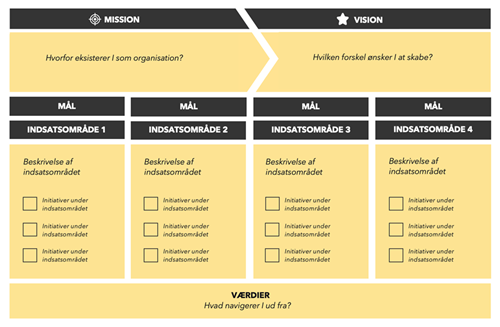
Here you can see an example of a strategy from Greve Gymnasium developed on the basis of the method: https://greve-gym.dk/om-greve-gymnasium/om-gg/vision-strategi/
More articles
We write articles that can help top managers, boards, employees, citizens and business actors to succeed better - both together and separately.


Get the latest news on strategy implementation
If you want to keep up with the latest trends and developments in strategy realization, our LinkedIn page is the right place for you.
Visit us on LinkedIn